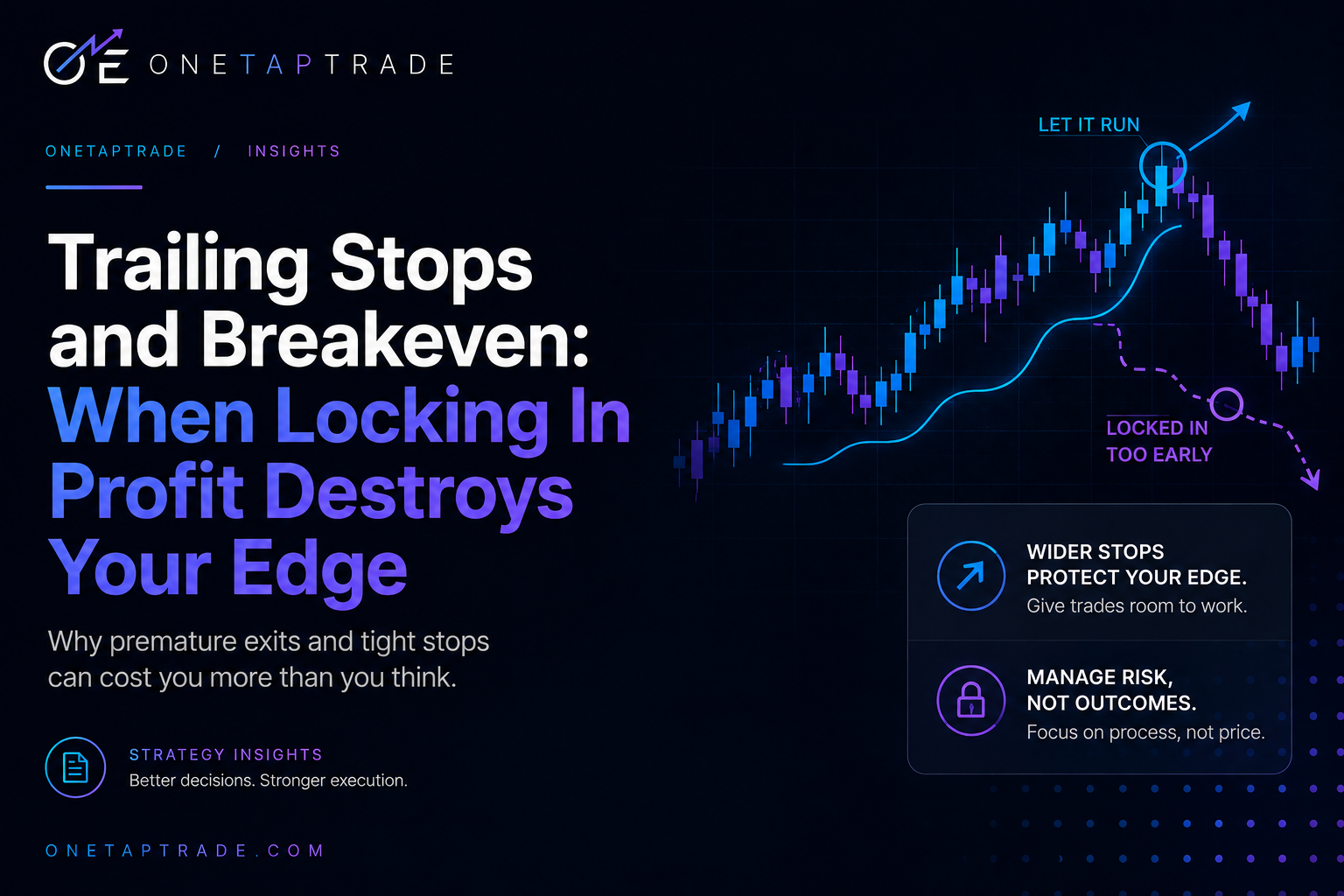
Trailing Stops and Breakeven: When Locking In Profit Destroys Your Edge
O N E T A P T R A D E / I N S I G H T S
In Profit Destroys Your Edge
Moving your stop to breakeven feels like free risk reduction. On some strategies it is. On others it quietly turns your best trades into scratches. This guide puts real backtest numbers on both cases, and gives you one rule for telling which kind of strategy you own.
Author: OneTapTrade Team · 28 Aug 2026 · 9 min read · Last updated: 28 Aug 2026
D I R E C T A N S W E R
A trailing stop or breakeven stop helps only when your strategy has no natural profit target, and hurts when it already has one. If your exit is a fixed take-profit or a reversion to a mean, a trail set inside the normal wobble of a trade will tap you out of winners that were on their way to the real target, cutting profit factor even as win rate climbs. If your exit is open-ended, as it is on breakout and trend systems, a trail is the mechanism that converts an unbounded move into realised profit. In a controlled test on three years of gold data, adding a 0.6 ATR trail to a mean- reversion system turned +71,467 pips into a 20,223 pip loss. On a trend system in the same programme of tests, a profit trail was the difference between +552 and +31,285.
What Does a Trailing Stop Actually Do?
A trailing stop is not a risk control. It is an exit rule wearing the costume of one.
Your initial stop loss controls risk. It is set before entry, it caps the loss, and it defines the R in every risk- to-reward number you quote. That is a risk control.
A trailing stop does something different. It watches the trade go your way, then follows price at a fixed distance, giving back a slice of open profit in exchange for protecting the rest. A breakeven stop is the same idea in one step: once the trade is up by some amount, the stop jumps to entry.
Both replace the exit you designed with a new exit driven by the noise in the price series. Whether that is an upgrade depends entirely on what your original exit was.
Why Does Locking In Profit Cost Money?
Think about what has to happen for a trail to change an outcome. Price must move far enough in your favour to arm the trail, then retrace far enough to tap it, then, in the world where you had not added it, recover and reach your original target. That sequence is not rare. On most instruments it is the ordinary shape of a winning trade. Price seldom travels from entry to target in a straight line. It advances, gives some back, advances again.
So every trail sits on a spectrum. Set it tight and it fires often, converting a large share of full winners into small ones. Set it wide and it almost never fires, which means it does nothing at all. There is no comfortable zone in between where it catches only the trades that were going to fail.
The reason is that winners and losers look identical early on. A trade that is 30 pips underwater at bar five might be your biggest winner of the month or your next stop-out, and no rule reading only the price path can tell them apart yet. Any exit acting on that early information is acting on noise.
ANATOMY OF A SCRATCHED WINNER
mean-reversion target: +65 pips
trail arms
trail tapped: +9 pips booked the remaining +56 pips never counted entry
time in trade
Fig. 1 — The routine dip before reversion. The trail arms, an ordinary pullback taps it, and a full winner is booked as a scratch.
A Worked Example: Four Trail Settings on Three Years of Gold
We ran this properly rather than arguing about it. The subject is a gold mean-reversion scalp whose exit rule is a reversion to a fast moving average. In other words, the strategy already has a profit target built into its logic.
The test used three years of five-minute XAUUSD data, 9,932 baseline trades, scored net of 25 pips per round turn. One thing changed between runs: the trailing stop. Entry rules, initial stop and time exit all stayed frozen.
CONFIGURATION NET RESULT PROFIT FACTOR WHAT HAPPENED
+71,467 1.04 No trail (baseline) Winners run to the mean exit as designed.
-5,388 1.00 Trail 0.5 arm / 0.5 distance Edge erased.
Trail 0.6 arm / 0.6 distance -20,223 0.99 Worse than not trading.
+40,533 1.02 Trail 1.0 arm / 1.0 distance Fires less, costs less, still behind baseline.
+79,865 1.05 Trail 1.75 arm / 0.5 distance Only 76 trail exits in 9,932 trades. It does nothing.
Arming and trail distances in ATR multiples. Results net of 25 pips per trade on three years of XAUUSD five-minute data. Figures are backtested and illustrative; backtested results do not guarantee future performance. Read down the table and the rule writes itself. The more often the trail fires, the more it costs. It stops hurting only when set so far out that it never triggers, at which point you have added a parameter that does nothing.
The mechanism is visible in the exit tags. The baseline produced 7,046 exits at the mean target. With the trail arming early, that count fell to 5,899. Those 1,147 converted trades were the ones paying for all the losers.
NET RESULT BY TRAIL SETTING · 9,932 GOLD TRADES, NET OF 25 PIPS
+79.9k +71.5k +80k
+40.5k
0 -5.4k -20.2k no trail 1.75 / 0.51.0 / 1.0 0.5 / 0.5 0.6 / 0.6 (never fires)
Fig. 2 — The same strategy, five exit configurations. Tighter trails fire more often and cost more.
Why Does the Win Rate Rise While the Account Falls?
This is the trap that keeps traders adding trails.
An earlier version of the same test produced a 74.1% win rate, which looks superb on any dashboard. The profit factor was 0.86 and the run lost money. Roughly 230 of 396 mean-exit winners had been converted into tiny trail exits.
Win rate rose because scratching a trade at a small profit still counts as a win. Profit factor fell because the average win collapsed while the average loss did not move. A trailing stop cannot make your losers smaller, since it only exists once a trade is in profit. It can only make your winners smaller.
That asymmetry is the whole story. Judge exit changes on profit factor and expectancy, never on win rate. A 74% win rate that loses money is an expensive way to feel good about your screenshots.
When Does a Trailing Stop Genuinely Help?
The honest answer is: often, on the other kind of strategy.
If your system enters on a breakout or a trend continuation, it has no natural target. The trade is worth whatever the move ends up being worth. Without a trail you are left holding open profit until a wide stop or a time exit hands it back.
In a separate test on a gold trend system, the exit ladder mattered more than any entry filter. A static breakeven lock on its own produced +552 net, because it strangled 58 runner legs at a token profit. Adding a 150 pip profit trail behind the best price, on exactly the same entries over exactly the same window, produced +31,285 net with a maximum drawdown of 4,262.
The same pattern appeared on a Donchian breakout system, where a tight initial stop worked as a failed- breakout filter and the trail supplied the breathing room afterwards. Widening that initial stop to 3.0 ATR halved the profit.
So the rule is not "trails are bad". It is narrower and far more useful:
IF YOUR EXIT IS EXAMPLE VERDICT ON TRAILING
A defined target already in theReversion to a moving average,Do not add one. It can only cut winners logicfixed take-profit, range targetshort.
Open-ended Breakout, trend continuation,Add one. It is how the profit gets momentum riderealised.
A wide stop plus a time exit on aOrder-flow and market-structureBe careful. Big winners go underwater low win-rate trend followersystems holding 40 barsfirst, so early exits guillotine them.
Categories drawn from backtests across mean-reversion, breakout and trend-following systems on gold. Illustrative, not a recommendation for any specific instrument.
The third row deserves its own warning. On a low win-rate trend follower we tested, adding a fixed take- profit lifted win rate from 45% to 57% and collapsed profit factor to roughly 1.0. Adding breakeven plus a loss-cut took the same system from +216,000 to -66,000. On a strategy whose edge lives in a handful of long rides, the drawdown is the cost of the edge. You cannot cut it by exiting sooner. You cut it by trading smaller, which is a position sizing decision, not an exit decision.
What Backtest Bug Makes Trailing Stops Look Brilliant?
Before you trust any trailing stop result, including your own, check one thing.
Inside a single bar you see four prices: open, high, low and close. You do not know the order they happened in. If your backtest updates the trailing high-water mark using this bar’s high, tightens the stop, then tests that new stop against this bar’s low, it has silently assumed the favourable ordering on every bar in the history.
On the gold system above, that one ordering choice was the difference between +341,884 at profit factor 1.21 and +75,322 at profit factor 1.05 for an identical rule set. The flattering version was accounting fiction.
The bug is easy to miss because a 0.3 to 0.5 ATR trail is a fraction of a single five-minute gold bar, so the engine is making that choice constantly. The fix is a one-line reordering: test exits first, update the trail afterwards, so the stop in force during bar i is the one that was set at the close of bar i-1.
The general form of the problem is that any exit finer than the bar range will manufacture profit. If you are testing trails, use the finest data you have, then re-run at a coarser resolution and confirm the sign of the result does not flip.
What Mistakes Do Traders Make With Trailing Stops?
Adding a trail to fix drawdown. Drawdown lives in the losers. Trails only touch winners. The tool does not connect to the problem.
Optimising the trail distance. If the best setting is one so wide it never fires, the honest reading is that the strategy does not want a trail, not that you found a good parameter.
Judging on win rate. Every trail raises win rate. That is the symptom, not the result.
Stacking breakeven on top of a trail. Two rules that both cut winners short do not cancel each other out.
Testing exits on the same data you tuned entries on. An exit rule fitted in-sample is as overfit as an entry rule fitted in-sample, and it hides better.
Believing the flattering intrabar result. If a trail suddenly turns a marginal system excellent, suspect the engine before you celebrate.
Where Does This Fit in Your Workflow?
Exits belong in the backtest stage and they need the same discipline as entries. The sequence that works is: freeze the entry logic, change exactly one exit rule, re-run on the full history net of costs. If the change does not improve profit factor across a few hundred trades in mixed conditions, it does not ship, however good the equity curve looks in the first month.
Then forward test the version you chose. Exit rules meet real spread, real slippage and real fill behaviour in ways a backtest smooths over, and a trail that fires often is precisely the rule most exposed to that gap.
K E Y T A K E A W A Y S
A trailing stop is an exit rule, not a risk control. Your initial stop is the risk control.
If your strategy already has a profit target, a trail can only shrink winners. On a gold mean-reversion system it turned +71,467 into -20,223.
The more often a trail fires, the more it costs. It stops hurting only when set so wide it never triggers.
Trails always raise win rate and often lower profit factor. One run showed a 74.1% win rate at profit factor 0.86.
On open-ended breakout and trend systems the opposite holds. A 150 pip profit trail took one system from +552 to +31,285.
On low win-rate trend followers, early exits kill the edge. Breakeven plus a loss-cut took one from +216,000 to -66,000.
Check the intrabar ordering in your engine. Updating the trail before testing exits inflated one result from +75,322 to +341,884.
Control drawdown with position sizing, not by exiting live trades sooner.
Frequently Asked Questions
Should I use a trailing stop or a fixed take-profit?
It depends on whether your strategy has a natural target. Mean-reversion, range and fade systems have one built into the logic, so a fixed exit at that target is correct and a trail placed inside the normal wobble will scratch winners before they get there. Breakout, momentum and trend systems have no natural target, so a trail is the mechanism that turns an open-ended move into realised profit. The choice is a question about your strategy type, not about which tool is better in general.
Does moving my stop to breakeven reduce risk? It reduces risk on that individual trade and it can reduce your overall expectancy at the same time. Once the stop sits at entry the trade can no longer lose, but it can now be closed for nothing by an ordinary pullback that would have resolved in your favour. In tested runs, breakeven showed the same failure mode as a trailing stop, milder in size but identical in direction. If you want lower risk, reduce position size, which lowers risk on every trade without changing which trades win.
Why did my win rate improve but my profit shrink?
Because trailing and breakeven stops can only act on trades that are already in profit. They convert some full winners into small winners, which raises the count of winning trades while lowering the average size of a win. Losses are untouched, since the rules never engage on a trade that goes straight against you. The result is a better looking win rate attached to a worse payoff ratio. Judge every exit change on profit factor and expectancy instead.
What is the best trailing stop distance? There is no universal number, and if your optimisation lands on a distance so wide the trail almost never fires, that is the test telling you the strategy does not want one. In a five-configuration sweep on gold, settings at 0.5 and 0.6 ATR both produced losses, while a 1.75 ATR arming distance produced only 76 trail exits across 9,932 trades. Fit the distance to the volatility of your instrument and timeframe, then confirm on out-of-sample data that the trail improves profit factor rather than win rate.
Can a trailing stop reduce my maximum drawdown?
Rarely, because drawdown is created by losing trades and a trail only engages on winners. What usually happens is that the trail lowers your average win, so the same run of losses represents a larger share of the equity curve and drawdown as a percentage gets worse rather than better. The controls that genuinely reduce drawdown are position sizing, an entry filter that skips low-quality setups, and a cap on how much risk any single trade may carry.
Why does my trailing stop work in the backtest but not live? The most common cause is intrabar resolution. Your engine sees only the open, high, low and close of each bar and has to guess the order they occurred in, and if it updates the trailing high before testing the stop it always guesses in your favour. In one test that single ordering choice changed the result from +75,322 to +341,884 on identical rules. Fix it by testing exits before updating the trail, then re-run on finer data and confirm the conclusion holds.
Should I add a trailing stop to a prop firm challenge bot? Only if the underlying strategy is the open-ended type. Challenge rules push traders toward anything that looks like tighter risk control, and that pressure is exactly what leads people to bolt a trail onto a mean-reversion system and quietly remove its edge. The daily loss limit is a constraint on position sizing and on how many trades run at once, so solve it there. Trade smaller so the worst realistic day fits inside the limit, and leave the exit logic doing what it was validated to do.
O n e T a p T r a d e — T h e U n f a i r A d v a n t a g e OneTapTrade is a technology platform for building, backtesting and automating trading strategies. Nothing in this article is financial advice or a recommendation to trade any instrument. All figures are drawn from backtested or simulated (demo) environments; backtested and simulated results do not guarantee future performance. Trading involves substantial risk of loss. Always test strategies on simulated accounts before risking capital.