Backtesting vs Forward Testing: How to
O N E T A P T R A D E / I N S I G H T S
Validate a Strategy Before You Risk Real
Capital
A backtest tells you how a strategy would have behaved. A forward test tells you how it actually behaves on data nobody has seen yet. Confusing the two is the most expensive mistake in automated trading. Here is the full validation pipeline, what each stage can and cannot prove, and the numbers that decide when a strategy has earned real money.
Author: OneTapTrade Team · 24 Aug 2026 · 10 min read · Last updated: 24 Aug 2026
D I R E C T A N S W E R
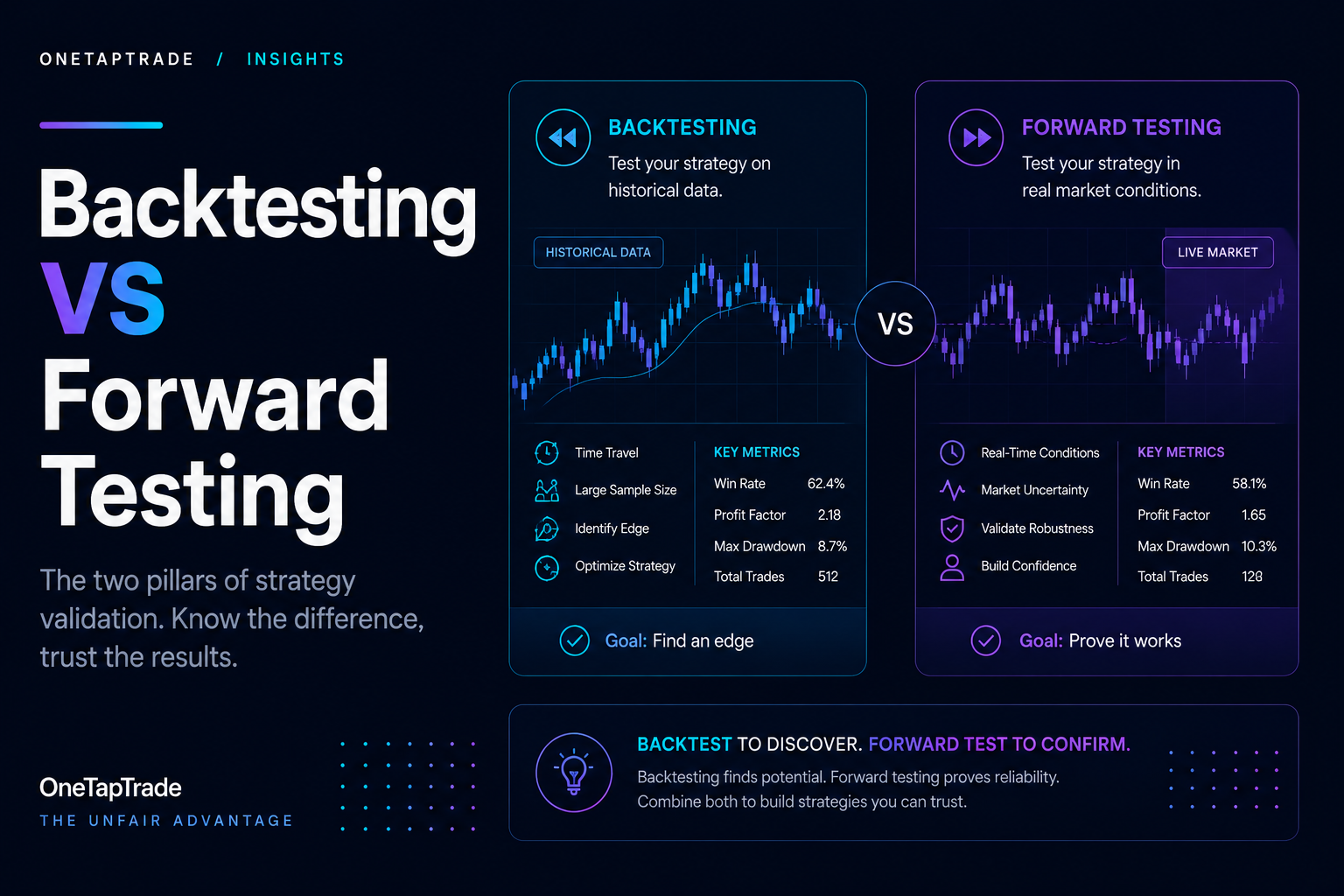
Backtesting replays a strategy’s rules over historical data to estimate how it would have performed. Forward testing freezes the finished strategy and runs it in real time on a demo account, on live prices, spreads and slippage the strategy has never seen. A backtest can prove a strategy is bad, but only a forward test can give you real evidence it is good, because forward data cannot leak into the design. The professional sequence is backtest, then walk-forward analysis, then a fixed-length forward test on demo, then small live size.
What Is Backtesting?
A backtest applies your entry and exit rules to historical price data, bar by bar, and records every trade the rules would have taken. From those trades it computes the statistics that describe the strategy: win rate, average win and loss, profit factor, maximum drawdown, Calmar ratio.
Backtests are fast and cheap. You can evaluate five years of trades in seconds, which makes them the right tool for the first question: is this idea worth any further attention at all? Most ideas die here, and that is the point. A backtest that shows no edge on the data the strategy was designed for is a definitive answer.
What a backtest cannot do is prove the edge is real. You built the rules while looking at this data, or at data like it. Some of the measured performance is genuine edge and some is curve fit, the strategy memorising the past, and the backtest cannot tell you the proportions.
What Is Forward Testing?
A forward test runs the finished strategy on data that did not exist when the strategy was built. In practice that means:
- Freeze the strategy. Rules, parameters, risk settings. No tweaking once the test starts. A strategy
that gets adjusted mid-test has its test restarted.
- Run it live on a demo account. Real ticks, real spreads, real slippage, real news candles, simulated
money.
- Fix the evaluation window in advance. A number of trades or a number of weeks, decided before you
start, so you cannot stop early on a lucky streak.
- Compare against the backtest’s promise. If the backtest said 55% win rate and profit factor 1.6, the
forward test’s job is to confirm or deny those specific numbers.
Forward testing is slow, and that slowness is the price of its honesty. Hindsight cannot leak into data that has not happened yet.
How Does Walk-Forward Analysis Fit In?
Walk-forward analysis simulates forward testing inside history, and it belongs between the backtest and the demo run. The data is split into rolling windows: optimise the parameters on months one to six, then trade month seven with those parameters frozen. Slide everything forward one month and repeat across the whole dataset.
Only the out-of-sample segments, the months traded on frozen parameters, are stitched together into the final equity curve. Every trade in that curve was taken with settings chosen without seeing the period it traded in. If the in-sample results are excellent but the stitched out-of-sample curve is flat, the strategy is fitting noise and no demo test is needed to reject it.
THE VALIDATION PIPELINE
- Backtest2. Walk-forward3. Forward test4. Small live
kills bad ideas fastexposes curve fitdemo, frozen rulesscale up slowly
~100 ideas in ~15 survive ~5 survive 1-2 earn real capital
Each stage exists to reject strategies cheaply before the next, more expensive stage. Attrition is the system working, not the system failing.
Fig. 1 — The four-stage validation pipeline. Idea counts are illustrative of a typical research funnel.
What Does a Forward Test Catch That a Backtest Misses?
Curve fit. The big one. Parameters tuned to past noise simply stop working on new data, and forward performance collapses toward zero edge.
Real spread behaviour. Backtests usually assume a fixed spread. Live spreads widen at rollover, around news and in thin sessions. Scalping strategies with small average winners are routinely profitable on fixed-spread backtests and dead on live spreads.
Slippage and fills. Your backtest fills at the bar’s close. Your live order fills where the market lets it, which on a fast breakout candle can be meaningfully worse.
Regime dependence. A backtest window dominated by one market character flatters any strategy tuned to that character. Forward time eventually serves up the other regime and shows you the bill.
Operational reality. Disconnections, requotes, platform quirks, weekend gaps. None of these exist in a simulator.
A Worked Example: The Backtest Promise vs the Forward Verdict
Suppose a gold strategy leaves the design phase with these backtested statistics over 420 trades: win rate 56%, average winner 1.4R, average loser 1.0R, profit factor 1.62, maximum drawdown 8%.
You freeze it and forward test on a $10,000 demo account risking 0.5% ($50) per trade, with the window fixed in advance at 60 trades. Two outcomes and how to read them:
Outcome A, confirmation. The forward run delivers 53% wins, profit factor 1.41, drawdown 6%. Every number is a little worse than the backtest, and that is exactly what a healthy result looks like: some backtest performance is always optimistic. The strategy earns a small live allocation.
Outcome B, rejection. The forward run delivers 48% wins and profit factor 0.92. That is not "bad luck to push through". Over 60 trades, a genuine 56% strategy delivering 48% or worse is uncommon, and a profit factor below 1.0 means the edge did not show up at all. The honest conclusions are that the backtest was overfit, the market changed, or execution costs were underestimated. All three mean the same thing: back to research, not on to live money.
KILLS A STRATEGY STAGE DATA USED WHAT IT PROVES TYPICAL DURATION WHEN
Minutes Backtest All history The idea has no edgePF ≤ 1.0 after costs (rejection only)
Hours Walk-Rolling out-of-Parameters surviveOOS curve flat vs in- forwardsample slicesunseen historysample
4-12 weeks / 50+ ForwardLive demo, futureEdge exists now, after realStats far below trades testdatacostsbacktest promise
Small live Real account,Execution and psychology4+ weeks Live fills diverge from minimum sizehold updemo Durations and thresholds are illustrative guidelines, not universal rules. Results at every stage are simulated or backtested and do not guarantee future performance.
What Mistakes Do Traders Make With Forward Testing?
Tweaking mid-test. Every adjustment restarts the clock. A forward test of a strategy you changed last week is a one-week test.
Stopping on a high. Ending the test early because the first fortnight went well reintroduces the exact selection bias the test exists to remove. Fix the window first, honour it.
Judging on too few trades. Twenty trades tell you almost nothing about a 55% win-rate system; the noise band is wider than the edge. Fifty trades is a minimum, more is better.
Testing only one regime. A forward test that happened to run through a quiet range validates the strategy for ranges. If the window never contained a trend, a news shock or a volatile week, the validation is partial and should be labelled as such.
Moving to live at full size. The step after a passed forward test is minimum live size, because live fills and demo fills are not identical. Scale up only after live execution matches demo execution.
Where Does This Fit in Your Workflow?
Validation is the bridge between building and deploying, and it is where discipline pays more than cleverness. Create the strategy, backtest it against history that includes both trending and ranging conditions, walk-forward it to check the parameters are not memorised, then let a fixed-window demo forward test deliver the verdict on live data. Only strategies that survive all four gates earn real capital, and even then they start small and stay monitored. Every stage is designed to reject; the strategies you actually deploy are simply the ones that refused to be rejected.
K E Y T A K E A W A Y S
A backtest can prove a strategy is bad. Only forward data can provide real evidence it is good.
Forward testing means frozen rules, a live demo account, and an evaluation window fixed before the test starts.
Walk-forward analysis sits between the two: it simulates forward conditions inside history and exposes curve fit in hours instead of months.
Expect forward results to be modestly worse than the backtest. Slight degradation is normal; collapse is a rejection.
Fifty trades is a practical minimum before a forward test means anything. Twenty is noise.
A forward test only validates the regimes it ran through. Note what the window contained.
Pass the test, then start live at minimum size. Demo fills and live fills are cousins, not twins.
Frequently Asked Questions
What is the difference between backtesting and forward testing?
Backtesting replays a strategy’s rules over historical data to estimate past performance, while forward testing runs the frozen strategy in real time on new, unseen market data, usually on a demo account. The critical difference is information leakage: a backtest is performed on data the designer could see while building the strategy, so results can be flattered by curve fitting. Forward data did not exist at design time, so it cannot leak.
How long should you forward test a trading strategy?
Judge by trade count first and calendar time second. A practical minimum is 50 completed trades, and 100 or more gives substantially tighter statistics. For an intraday system taking a few trades per day, that typically means four to twelve weeks. Also check what the window contained: a forward test that never saw a trending week, a news shock or a volatile session has only validated part of the strategy’s future.
Is demo trading the same as forward testing?
Demo trading becomes forward testing when three conditions are met: the strategy is frozen before the test starts, the evaluation window is fixed in advance, and results are compared against a specific backtested benchmark. Casually running a bot on demo while adjusting it whenever it loses is practice, not validation, because every adjustment restarts the evidentiary clock.
What is walk-forward optimisation? Walk-forward optimisation splits historical data into rolling windows, optimises the strategy’s parameters on each in-sample window, then trades the following out-of-sample window with those parameters frozen. The out-of-sample segments are stitched into a single equity curve in which every trade used settings chosen without seeing that period. It is the fastest reliable way to detect an overfit strategy before spending months on a demo forward test.
Why do strategies pass backtests but fail live? The usual causes, roughly in order of frequency: curve fitting, where parameters memorised historical noise; underestimated costs, especially live spread widening and slippage that a fixed-spread backtest never models; regime dependence, where the backtest window happened to favour the strategy’s style; and lookahead bugs, where the backtest accidentally used information that would not have been available at trade time. A disciplined walk-forward pass plus a demo forward test catches most of all four.
How much worse should forward results be than the backtest?
Some degradation is expected and healthy. As a rule of thumb, a forward profit factor within about 25 to 30 percent of the backtested figure, with a win rate a few points lower, is consistent with a real edge meeting real costs. A forward profit factor below 1.0, or a win rate that falls outside what chance would plausibly produce over the sample, is a rejection rather than a rough patch.
Can I skip forward testing if my backtest is really good? An exceptional backtest is a reason for more suspicion, not less, because extreme historical performance is exactly what overfitting produces. The better the backtest looks, the more valuable the forward test is, since it is the only stage that distinguishes a memorised past from a repeatable edge. The cost of forward testing is a few weeks of patience; the cost of skipping it is discovering the difference with real money. O n e T a p T r a d e — T h e U n f a i r A d v a n t a g e OneTapTrade is a technology platform for building, backtesting and automating trading strategies. Nothing in this article is financial advice or a recommendation to trade any instrument. All figures are drawn from backtested or simulated (demo) environments; backtested and simulated results do not guarantee future performance. Trading involves substantial risk of loss. Always test strategies on simulated accounts before risking capital.