Automated Trading for Prop Firm
OneTapTrade
INSIGHTS
Challenges:
What's Allowed and What Works
Passing a prop firm challenge is not only about finding a profitable strategy. Your automation also has to operate within the firm's trading rules, risk limits and execution
conditions. This guide explains how automated trading works in prop firm challenges, what firms commonly restrict, what tends to make automation more robust, and how to
test a system before putting it on a funded account.
AUTHOR: ONETAPTRADE TEAM 18 AUGUST 2026 12 MIN READ LAST UPDATED: 18 AUG 2026
Automated trading can be allowed in prop firm challenges, but the rules depend entirely on the specific firm and account programme. Some firms permit Expert Advisors, algorithmic systems and third-party automation, while others restrict certain strategies, execution methods, news trading, copy trading or forms of arbitrage. What works best is not a particular bot or indicator, but a clearly defined strategy that has been properly backtested, risk managed and designed around the firm's actual rules. Always check the current terms of the specific prop firm before deploying automation.
What Is Automated Trading in a Prop Firm Challenge?
Automated trading means using software to execute trades according to predefined rules rather than manually clicking every order.
For a prop firm challenge, that might mean an Expert Advisor on MetaTrader, an automated strategy connected through a supported platform, or an external system that sends orders to a compatible broker or trading account.
The important distinction is that automation does not create the trading edge.
If your strategy loses money manually, turning it into a bot does not solve the underlying problem.
Automation simply makes the execution of your rules more consistent.
Consider a simple gold strategy. Your rules might say:
Trade XAUUSD during the New York session.
Wait for a defined market structure break.
Enter after a specific pullback.
Risk 0.5% of account equity.
Place the stop loss immediately.
Target 1.5R.
Stop trading after two losses in one day.
ONETAPTRADE 1 OneTapTrade
A trader can execute those rules manually. A properly built automated system can execute the same rules without hesitation, missed entries or emotional intervention.
That distinction is central to the OneTapTrade philosophy.
Automation is not the edge. Consistent execution of a tested edge is the advantage.
How Do Prop Firm Challenge Rules Affect Automated
Trading?
Prop firms do not all operate under the same rulebook. Before building or deploying automation, you need to understand the exact restrictions attached to the account you are trading.
Common areas include daily loss limits, maximum drawdown, permitted trading strategies, news restrictions, holding requirements, overnight positions, weekend exposure, minimum trade duration and the use of Expert Advisors or other automated systems.
The numbers can also vary significantly. Imagine a challenge with:
Rule Example
Starting balance $100,000
Daily loss limit 5%
Maximum loss 10%
Profit target 10%
Risk per trade 0.5%
Maximum planned trades per day 3
A 5% daily loss limit sounds large. It is not. On a $100,000 account, 5% represents $5,000. If your strategy risks 1% per trade, five consecutive full losses could consume the entire daily allowance. At 0.5% risk, ten full losses would theoretically reach the same amount.
The second approach gives the strategy considerably more room to operate.
But there is an important catch. The firm's definition of daily loss may include more than closed trades. Depending on the programme, floating losses, commissions, swaps or other account-level calculations may matter.
That means your automation needs to understand the account's actual risk environment.
ONETAPTRADE 2 OneTapTrade
What Trading Strategies Are Commonly Restricted?
This is where traders need to be particularly careful. A strategy can be mathematically sound and still be unsuitable for a particular prop firm if it violates that firm's rules.
Restrictions commonly concern techniques such as latency arbitrage, certain forms of high-frequency trading, exploiting pricing discrepancies, prohibited copy trading, account manipulation or trading around restricted events.
The exact definition matters. For example, news trading can mean very different things depending on the programme.
One firm might permit trades to remain open through major economic announcements. Another might prohibit opening or closing trades during a defined period around the announcement. A third may have separate rules for evaluation accounts and funded accounts.
The same applies to automated systems. One firm may openly support EAs. Another may allow automation but prohibit specific execution behaviours.
Never assume that because a bot works technically, it is permitted operationally.
Read the current rules before you deploy.
How Can You Tell If an Automated Strategy Is Suitable for
a Prop Firm Challenge?
Start with the strategy, not the prop firm. You need to know what your system actually does.
A useful strategy specification should define at least: entry conditions, exit conditions, stop loss, take profit, position sizing, maximum simultaneous positions, trading hours, instruments, maximum daily trades, maximum daily loss, maximum strategy drawdown, news behaviour, weekend behaviour, slippage assumptions and spread assumptions.
This turns an idea into a measurable system.
Suppose a trader says: "I trade gold when the market breaks structure and pulls back." That is not yet an automation specification.
What qualifies as a structure break? How many candles are involved? What constitutes the pullback? Where is the stop? What happens if the spread widens? What happens if the signal appears two minutes before a major economic release? What happens after two consecutive losses?
Those questions are not programming details. They are strategy details.
Until the answers are defined, there is nothing reliable to automate.
ONETAPTRADE 3 OneTapTrade
How Should You Risk Manage an Automated Prop Firm
Strategy?
Risk management should be designed before the bot starts trading.
Consider a $100,000 challenge with a 10% maximum loss. A trader risking 2% per position can lose $2,000 on a single trade. Five full losses would represent $10,000. The challenge could be over.
Now consider the same strategy at 0.5% risk. Each full loss is $500. Five consecutive losses equal $2,500.
That does not make the strategy profitable. It simply gives the strategy more statistical and operational room.
This is why position sizing deserves as much attention as entry logic. A strategy with a 55% win rate can still experience several consecutive losses.
Expectancy
(0.55 × 1.5R) − (0.45 × 1R) = +0.375R per trade
At 0.5% risk: +0.1875% theoretical average per trade At 1.0% risk: +0.375% theoretical average per trade
But so does the size of every drawdown.
Changing position size does not improve the underlying edge. It changes the path the account takes.
What Does a Prop Firm Automation Workflow Look Like?
A robust system should move through several stages before it reaches a challenge account.
CREATE BACKTEST AUTOMATE DEPLOY MONITOR
OneTapTrade workflow: move from a defined idea to tested, executable and monitored trading. Create. Start with a trading idea. Define exactly what creates an entry and what invalidates it. Do not start by asking what the bot should do. Start by asking what the strategy should do.
Backtest. Test the rules against historical data. Measure more than net profit. Look at win rate, profit factor, expectancy, maximum drawdown, average win, average loss, number of trades, consecutive losses, monthly performance and performance by market session.
ONETAPTRADE 4 OneTapTrade
A $20,000 backtest profit means little without the context of how it was produced.
Automate. Once the rules have evidence behind them, convert them into executable logic. This is where automation should remove execution friction. The goal is not to create a mysterious machine that decides what to trade. The goal is to make your defined strategy executable.
Deploy. Deploy only after checking compatibility with the broker, platform and prop firm. Confirm the firm's current rules. Confirm the account's drawdown calculations. Confirm the automation behaves correctly in the intended environment.
Monitor. Automation does not mean abandonment. You still need to monitor execution, drawdown, slippage, spread, connection issues, position sizing, rule compliance and strategy behaviour.
The trader remains responsible for deciding whether the system should continue running.
What Does a Good Prop Firm Automation System Actually
Look Like?
The strongest systems are usually less complicated than traders expect.
Consider a strategy that uses six indicators, twelve parameters and dozens of conditions. It may look sophisticated. But complexity creates more opportunities for overfitting.
Now consider a system with three clearly defined conditions, one entry model, one risk model and strict execution rules. It may look less impressive. That does not make it weaker.
A good automated system should be understandable enough that the trader can explain why every major decision exists.
This is particularly important for prop firm challenges. You do not want to discover after deployment that a hidden rule, unusual execution condition or poorly defined parameter causes the system to behave differently from your backtest.
How Does a Worked Prop Firm Example Compare at
Different Risk Levels?
Consider a hypothetical $100,000 prop firm challenge. The strategy has a 52% win rate, an average winner of 1.8R, an average loser of 1R and 100 trades. No commissions or slippage are included in this simplified example.
The expectancy is:
(0.52 × 1.8) − (0.48 × 1) = +0.456R
Before: 1% risk per trade. Average theoretical expectancy: 0.456R × 1% = 0.456% per trade. A 10-loss sequence would represent 10 × 1% = 10%. That could be enough to breach a 10% maximum drawdown rule before considering any other losses, open positions or costs.
After: 0.5% risk per trade. Average theoretical expectancy: 0.456R × 0.5% = 0.228% per trade. The same ten-loss sequence becomes 10 × 0.5% = 5%.
The strategy itself has not changed. The win rate has not changed. The reward-to-risk profile has not changed. Only the position size changed.
That can materially change whether the strategy has enough room to survive normal variance within the challenge rules.
This is why "How much should I risk?" can be more important than "How much can this strategy make?"
ONETAPTRADE 5 The numbers above are simplified. Real trading introduces spread, commissions, slippage, execution delays and changing market conditions.
ONETAPTRADE 6 OneTapTrade
What Risk Level Should You Consider for a Prop Firm
Challenge?
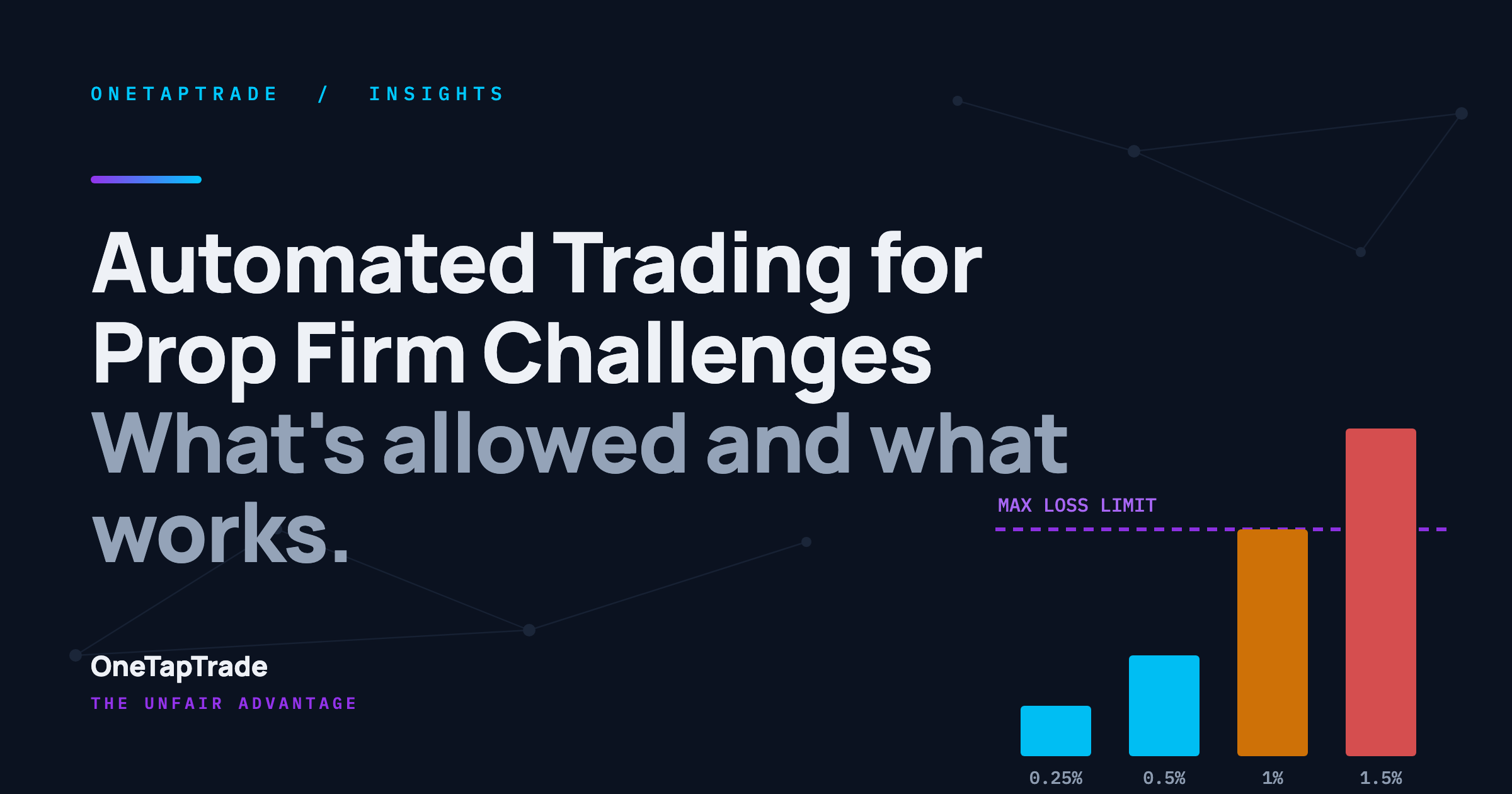
There is no universal percentage that is correct for every trader or strategy. But the relationship between risk and drawdown can be illustrated clearly.
-15%
-10%
-7.5% 10-loss drawdown -5%
-2.5%
0.25%0.5%0.75%1%1.5% Risk per trade
Drawdown produced by ten consecutive losses, by risk per trade. The same ten-loss streak is routine at 0.25% risk and potentially terminal at 1% or above when a 10% maximum loss limit applies. The strategy never changed. Only the position size did.
Risk per trade 5 consecutive losses 10 consecutive losses 20 consecutive losses
0.25% −1.25% −2.50% −5.00%
0.50% −2.50% −5.00% −10.00%
0.75% −3.75% −7.50% −15.00%
1.00% −5.00% −10.00% −20.00%
1.50% −7.50% −15.00% −30.00%
Results are illustrative. Your outcomes will vary. The table demonstrates an important principle. A strategy does not need to change for the account's risk profile to change dramatically.
Position sizing can determine whether normal losing streaks are manageable or catastrophic.
ONETAPTRADE 7 OneTapTrade
What Mistakes Do Traders Make With Automated Prop
Firm Challenges?
Assuming every prop firm allows the same automation
They do not. Rules differ between firms and programmes. Always verify the current terms.
Optimising for the profit target
A trader may build a strategy specifically to make 10% as quickly as possible. That can encourage excessive risk. The objective should be a robust process that can operate within the account's constraints.
Ignoring losing streaks
A 60% win rate does not mean losses happen one at a time. Five or more consecutive losses can occur even in a strategy with positive expectancy. Your position size needs to account for that possibility.
Trusting a backtest too much
A backtest is not a prediction. Historical data cannot perfectly reproduce future spreads, liquidity, slippage or market behaviour. A strategy that makes 30% in a backtest can behave very differently in live execution.
Automating an undefined strategy
If you cannot explain the rules clearly, automation will not fix the ambiguity. It will simply execute ambiguous rules faster.
Ignoring execution costs
A strategy with a small statistical edge can be particularly sensitive to spread and slippage. This matters even more for systems trading frequently.
Treating automation as set and forget
Technology can execute trades. It cannot determine whether the strategy still has an edge, whether the broker environment has changed or whether a prop firm's rules have been updated. The trader remains in the loop.
ONETAPTRADE 8 OneTapTrade
How Can You Test Automation Before Using It in a Prop
Firm Challenge?
A sensible validation process should use multiple stages.
First, backtest the strategy. Then test it on data that was not used to build the strategy. This helps expose overfitting.
Next, forward test the system in a live or simulated environment. Compare actual execution with your historical assumptions.
If your backtest assumed 0.1 pip slippage but the live environment regularly produces 1 pip of slippage, the original result may not be meaningful.
You should also stress test the strategy.
Ask what happens if:
- The win rate falls from 55% to 50%.
- Average slippage doubles.
- Spread increases during key entries.
- The strategy experiences ten consecutive losses.
- The first trade of the day loses.
- Three trades fail in succession.
- A major market event produces abnormal volatility.
A robust system does not need perfect conditions. It needs enough room to survive imperfect ones.
Where Does Automated Prop Firm Trading Fit in the
OneTapTrade Workflow?
The biggest mistake is thinking the workflow starts with "build a bot". It starts with the strategy.
Create. Turn the trading idea into explicit rules.
Backtest. See whether those rules have historically demonstrated a measurable edge.
Automate. Turn the tested rules into consistent execution.
Deploy. Connect the strategy to a compatible broker or prop firm environment after checking the rules.
Monitor. Keep the trader involved in performance, risk and system behaviour.
That is the model behind OneTapTrade. The technology is there to reduce the friction between having a strategy and executing it consistently. It is not there to replace the trader's judgement.
The future is not Human versus Machine. It is Human + Machine.
ONETAPTRADE 9 OneTapTrade
What Are the Key Takeaways About Automated Trading
for Prop Firms?
KEY TAKEAWAYS
- Automated trading may be permitted by a prop firm, but the rules vary between firms and
programmes.
- Your strategy needs to be defined before it can be automated properly.
- Automation improves execution consistency. It does not create an edge.
- Position sizing can determine whether normal losing streaks remain within a firm's drawdown limits.
- Backtests should account for spread, slippage, commissions and realistic execution assumptions.
- Forward testing helps identify the gap between historical assumptions and live behaviour.
- The trader should remain responsible for strategy, risk and deployment decisions.
What Are the Frequently Asked Questions About
Automated Trading for Prop Firm Challenges?
Can I use a trading bot for a prop firm challenge?
Some prop firms allow automated trading systems, including Expert Advisors, while others restrict particular strategies or execution methods. The rules can also differ between evaluation and funded accounts. Always check the current terms of the exact programme you intend to use. Technical compatibility does not automatically mean the strategy is permitted.
Is automated trading allowed on FTMO and other prop firms?
Many established prop firms have rules covering automated trading, but the permitted methods and restrictions can change. You should read the current rules published by the specific firm rather than relying on an old review or social media post. Pay particular attention to news trading, copy trading, arbitrage, holding periods and prohibited execution techniques. What is allowed by one firm may not be allowed by another.
What is the best risk per trade for a prop firm challenge?
There is no single risk percentage that works for every strategy or challenge. A trader should consider the firm's daily loss limit, maximum drawdown, strategy expectancy and potential losing streak before selecting position size. Lower risk generally provides more room for normal variance, but it also reduces the speed at which a strategy can reach a target. Risk should be designed around survival and repeatability rather than simply reaching a profit target quickly.
ONETAPTRADE 10 OneTapTrade
Frequently Asked Questions
Can a trading bot pass a prop firm challenge?
An automated strategy can potentially meet a challenge's objectives if the strategy has a genuine edge and the automation operates within the firm's rules. There is no reliable bot that can guarantee a pass. Historical performance can also differ from live performance because of spread, slippage, execution and market conditions. The right question is whether the underlying strategy is robust enough to justify deployment.
Do prop firms allow Expert Advisors?
Some prop firms permit Expert Advisors, but permission is not universal and may come with restrictions. A firm can allow EAs while prohibiting certain trading techniques used by particular EAs. Traders should check the current rules for their exact account type before deployment. Never assume that an EA being technically compatible means it is automatically compliant.
Is automated trading better than manual trading for prop firms?
Neither approach is automatically better. Manual trading gives the trader direct control over every decision, while automation can provide more consistent execution of predefined rules. Automation can be particularly useful when a strategy depends on precise entries, exits or risk controls. However, automation does not remove the need for strategy development, testing or risk management.
How do I test a trading bot before using it on a prop firm account?
Start by backtesting clearly defined rules against historical data. Then test the strategy on unseen data and forward test it in a simulated or controlled environment. Compare expected spread, slippage and execution with what actually occurs. Finally, test whether the strategy's risk profile remains compatible with the prop firm's daily loss and maximum drawdown rules.
DISCLAIMER
OneTapTrade is a technology platform and does not provide financial or investment advice. Automated trading involves significant risk. No strategy or automation system can guarantee profits or future performance. Backtested, simulated and historical results do not guarantee future results.
ONETAPTRADE 11